Close to Christmas Nordplus mobility brought me to the Norwegian University of Life Sciences at Ås, appr. 40km south of Oslo. According to NMBU’s website, its mission is to contribute to the wellbeing of the planet through its interdisciplinary research on food, health, environmental protection, climate and sustainable use of natural resources. Coming from sustainable food studies at JAMK, I wanted to learn more about NMBU’s related studies.
As I had met Professor Geir Lieblein before, I already beforehand knew that food is included in NMBU’s two-year Master’s in Agroecology. Interested in experiential learning, I was also aware that they apply action learning in the first semester of the programme. And luckily, during my visit the first year students reflected their 1st semester learning experience in presentation-discussion type of exams which I could follow with the NMBU professors.
The 30 credit module ‘Action Learning in Farming and Food Systems’ was not only learning to be an agroecologist but also learning about learning. Through theory and practice, including two case studies (farm in transition to organic production and an urban food system case in Oslo), the students had learned about Kolb’s learning cycle and core competences in agroecology (participation, observation, reflection, visioning, interviewing, dialogue). They had moved from reductionist to holistic thinking, practised systems thinking with messy situations…
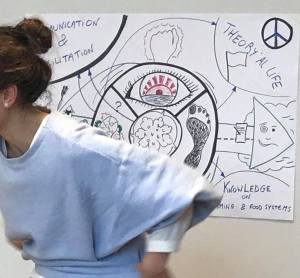
It was thrilling to see how different the strictly timed 10-minute presentations were, just like their presenters were different. Majority of the students (75%) in the programme come from outside Norway, I met students from France, Germany, Canada, Kenya and Norway. Students with different Bachelor degrees and previous pedagogical and work & life experiences. Many of them said that the semester had not been easy but the obstacles – messy situations – had been conquered with the tools learnt and practised together.
Perhaps some of my experiences at NMBU can be applied in our future curriculum of Bachelor’s Degree in Service Business (focusing in Sustainable Gastronomy) as we are already applying experiential learning to some extent. I was also invited to tell NMBU staff about JAMK curriculum development in progress, and especially share thoughts about how responsibility and sustainability issues are, and hopefully to an increasing extent, will be included in the new 2020 curricula.
Text and pictures: Minna Junttila, Specialist at JAMK University of Applied Sciences
 Sustainable Nordic Food