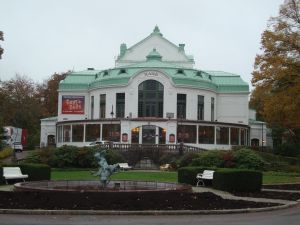
Kristianstad is a town founded by the Danish king Christian the 4th in 1614. The town does still bear witness of this period in its history through its architecture and the king’s emblem as ornaments around town. Along the Helge river, which is crossing through town, is the Tivoli garden with exotic trees, an orangeries and numerous stages, witnessing of a season with more activity. Here is also the baroque Kristianstad Theatre from 1906.
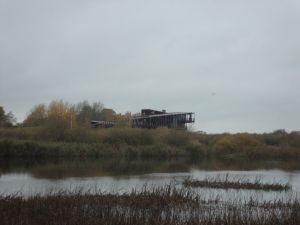
Apart from the beauty of its architecture it’s a town with lots of space for nature. As here the view from the shores of the river Helge.
I visited Kristianstad as a part of the Nordplus project on Nordic tastes and sustainability. On the recommendation of Viktoria Olsson our project partner at Kristianstad University my first visit was payed to the House of Beatrice. The house of Beatrice is a small social initiative working with social sustainability (In Swedish: Social Holdbarhed) in the township of Näsby.
The founder of House of Beatrice Elisabet Björck and her husband set op the foundation to work with the social challenges in the community – and with a special focus on working with the population in the community.
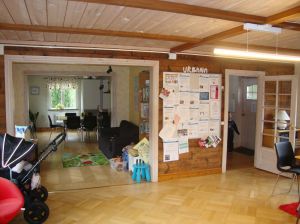
The challenges in Näsby is a very high proportion of unemployment among the immigrant communities residing here and generally challenges with acceptance of life situation and engagement in local community work. So Elisabeth and her husband created a space for multiple activities for families, as well as some income generating activities for people wanting to develop their possibilities for future work within the areas of catering, cooking, gardening and training in room service and cleaning – all with sustainable processes as a focal element. http://houseofbeatrice.se/
Another visit was paid to the Kristianstad’s county office, to meet with a consultant on institutional food service. “Kravs mat” is the primary principle for institutional food in Sweden and is a certification that evaluates the environmental load of food. As such it contains standards for animal welfare, how healthy the food is, social responsibility related to food production as well as the climate impact of the foods production and distribution. Quite a comprehensive package. Adding to this Sweden can boast of the fact that they are one of three countries in Europe that serves free lunch throughout primary and secondary school. The other two countries being Finland and France.
Finally, I met up with our project partner Viktoria Olsson at the University of Kristianstad. The university has great facilities for bringing the profession into the classroom. The indoor kitchen is huge with autumn colors pouring in the enormous windows covering the entire length of the kitchen.
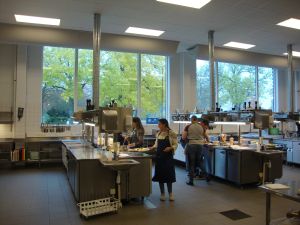
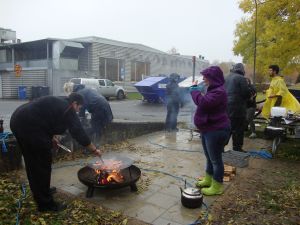
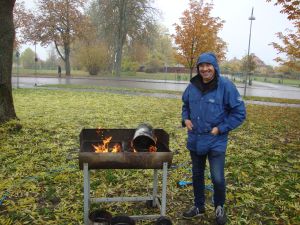
And beyond all expectations was the sensory laboratory, where students get a good possibility of working with sensory exercises much like an actual laboratory. And on the other hand, they also have great determination for bringing the classroom out – here in a very wet and very provisional outdoor kitchen.
https://www.hkr.se/program/gastronomi
https://www.hkr.se/program/magister-maltidsvetenskap
Victoria and I took a trip to the east coast to visit the sustainable food company FoodHills in Bjuv also known as SSEC – Swedish Surplus Energy Collaboration registered as a part of the Swedish Agricultural University https://sse-c.se/ Foodhill’s vision is to become leading in the area of circular food production contributing to a sustainable global development in this area.
Altogether a very inspiring visit – as of now we are busy planning further possibilities for student cooperation and internships.
Text and pictures: Marianne Søgaard Andersen, Lecturer in Nutrition and Health, University College Copenhagen. www.kp.dk Email MSAN@kp.dk
 Sustainable Nordic Food